

Africa's Digital Future Is Being Built on Two Tracks — and Skills Is One of Them
Executives who convened at Bloomberg’s Africa Business Summit in Johannesburg spoke candidly and constructively about the continent’s trajectory. Africa is home to an estimated 30–40% of the world’s critical minerals and a large, young, and increasingly digital-first population. Adoption of AI, fintech, and e-commerce is accelerating across multiple markets. From a business perspective, there was clear alignment: the opportunity is not theoretical—it is already materializing. The focus now is on translating this momentum into sustainable value creation, resilient partnerships, and scalable business models.
The summit also gave serious attention to what still needs to be built. e& Group CEO Hatem Dowidar noted that Africa has less than 500 megawatts of data-centre capacity serving 1.4 billion people — a fraction of what the AI era requires. Hyperscale facilities demand uninterrupted, reliable power — and while energy availability is improving across the continent, consistency of supply remains a challenge that investors are actively working to address. And as AXIAN Group CEO Hassanein Hiridjee pointed out, data sovereignty frameworks are still developing in many countries — a gap that both affects investor confidence and limits how AI systems can be trained on local data.
Sangudi pointed to Africa’s abundance of critical minerals and its large young population as genuine AI-era assets, before posing the sharpest question of the summit: “How do we avoid what we do now — exporting raw materials and importing technology?” It is the right question, and the summit’s discussions point towards an answer that depends as much on people as it does on physical infrastructure.
Skills and Infrastructure: Two Tracks, Not One
One of the things the Bloomberg summit reinforced is that the work of building Africa’s digital future runs on multiple tracks simultaneously. Upgrading energy grids, establishing data-centre capacity, and developing regulatory frameworks are long-horizon efforts that require coordinated investment from governments, multilaterals, and large private players — and that work is genuinely underway, as Dowidar’s $4.5 billion commitment to African digital infrastructure demonstrates. Skills development is a different kind of track: faster-moving, more immediately actionable, and something the private sector can drive without waiting for the longer cycles to complete.
A software engineer trained in Accra today can be contributing to an international client project within months. That timeline does not depend on grid stability or data sovereignty legislation. Physical infrastructure and human infrastructure reinforce each other — more trained engineers accelerate the deployment of the infrastructure being built, and better infrastructure creates more opportunities for those engineers to apply their skills. The two tracks move together, and investing in both simultaneously is how the gap between Africa’s digital ambition and its digital reality actually closes.
Hiridjee’s call at the summit for AI “made by Africans for Africans” speaks directly to this. The Korridor example he cited — a freight business transformed into a continent-wide electronic payment platform operating across 13 countries — shows what becomes possible when local knowledge, local talent, and a real African problem come together. That kind of solution does not arrive through infrastructure investment alone. It arrives when trained people have the tools and the confidence to build.
Where AmaliTech Fits Into This Picture
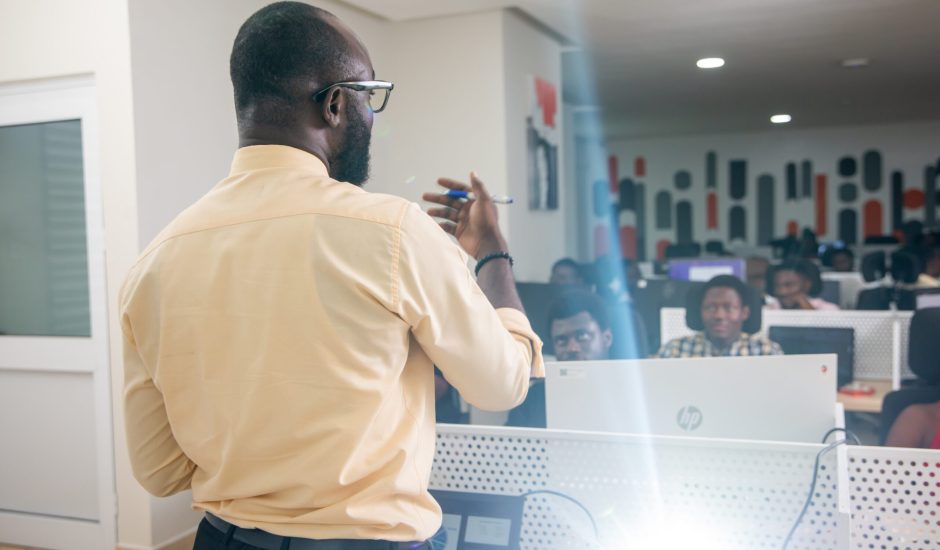
Since 2019, AmaliTech has been running free training academies in Ghana and Rwanda —multi-month programmes covering software development, data science, QA, and cloud computing. AI capability is now embedded in that curriculum, because the industry has moved and our graduates need to move with it. They are not being trained to be passive users of AI tools built elsewhere. They are being trained to build.
“If you cannot connect the people, you cannot do AI, you cannot do fintech. Africa today is the continent that is catching up — but lots of things are happening to change that.” — Hatem Dowidar, Group CEO, e&
Dowidar’s point about connecting people applies at every level — from broadband to training classrooms. AmaliTech’s contribution sits at the capability end of that chain: graduates who successfully complete our programmes move directly onto employment with AmaliTech, working on international and local client projects, building real experience from day one. The revenue those engagements generate funds subsequent cohorts in Ghana and Rwanda. AmaliTech’s own AI tools, are a product of that same pipeline — African engineers building globally-relevant technology.
For international companies, the practical case is straightforward. Our teams in Ghana and Rwanda operate within two hours of Central European time and work within agile frameworks. Every engagement also contributes to expanding the talent pipeline — so partnering with AmaliTech is simultaneously a commercial decision and a contribution to empowerment. The physical infrastructure is being built. The skills pipeline can grow right alongside it — and that work is already underway.
You can read the full Bloomberg article that informed this piece here.